








A gray outdoor heat pump unit with a circular fan grille sits on a concrete pad beside a dark wood-clad house, next to a gravel bed with ornamental grasses and a stepping-stone path.

No calling every shop in Richland County

How long a heat pump lasts in Wahpeton, ND

A heat pump in Wahpeton works year round, pulling heat out of cold air all winter and reversing in summer. That's a lot of hours on the compressor, and Richland County winters push it harder than most places. This page covers what actually wears a heat pump out here and when installing a new one makes more sense than another repair, so you're not stuck calling several companies and repeating the same story to each one.

Fill out one form

A heat pump in Wahpeton lasts about 12 to 15 years. That's shorter than the 15 to 20 you'll hear quoted for milder climates, and the reason is straightforward: this system doesn't get an off season. Richland County winters push the compressor to pull heat out of air that's often below freezing, sometimes well below, for months at a stretch. Every one of those hours is a load on the same compressor that also runs your air conditioning through the warm months. A furnace or an AC unit only works half the year. Your heat pump works all of it. That doubled duty is why the unit toward the lower end of that range, especially if it was never cleaned or serviced on schedule, and why one that got regular attention tends to land near 15. If yours was installed when you bought the house, the install date and any service records are worth finding, because they tell you where in that range you actually sit, and whether what you're noticing now is normal wear or something closer to the end.

A woman with long gray wavy hair in a knit sweater sits on a light sofa with a striped pillow, looking toward a window in a room with wooden shelving and a potted plant.
A woman in a gray cowl-neck sweater stands in a living room with built-in shelves, a lamp, a sofa with cushions, and a bright window behind her, looking to her right.
A woman with long wavy brown hair in a dark blue sweater sits on a sofa with cushions, looking off to the side, with a wooden shelving unit, houseplant and bright window behind her.
A woman with long dark hair in a gray knit sweater sits indoors smiling and looking off to the side, with a window, houseplant, framed picture, and shelving blurred behind her.

How a Heat Pump Runs in Winter

  • Below about 5 degrees, the compressor leans on backup electric resistance heat strips to keep up with the house.
  • Those strips draw a lot of power, so you'll see the bill climb during the coldest stretch of January and February.
  • A defrost cycle runs automatically every so often, briefly reversing the system to melt ice off the outdoor coil.
  • That outdoor coil sits exposed to wind and blowing snow, so it has to work harder here than in a mild climate.
  • The reversing valve switches the refrigerant flow direction between heating and cooling, and it only rests for a few weeks a year.
  • A heat pump that short-cycles or runs constantly in deep cold is usually undersized or losing refrigerant charge.

A heat pump heats by moving warmth out of outdoor air, even cold air, and sending it inside. In Richland County that gets harder as the temperature drops, and somewhere around 5 degrees the system can't pull enough heat on its own. That's when backup electric resistance strips kick in to carry the load alongside the compressor. Those strips use a lot more electricity than the compressor does by itself, which is why a heating bill can jump during a hard stretch of January or February without anything being wrong with the unit. The outdoor coil is doing the real work of pulling heat from the air, and in winter here it collects frost. The system runs a defrost cycle to deal with this, reversing briefly so hot refrigerant melts the ice off the coil before switching back to heating. This happens automatically, on its own schedule, all winter long. The part making that switch between heating and defrost, and between heating and cooling in summer, is the reversing valve. It's one of the few parts that works year round with almost no break, maybe a few weeks in spring and fall when neither heating nor cooling is needed. If a system is cycling on and off too fast, or running nonstop without catching up to the thermostat, in deep cold that usually points to a unit that was undersized for the house or one that's lost some of its refrigerant charge.

A gray outdoor condenser unit on a concrete pad beside a white horizontal-siding house, with refrigerant lines and conduit running to a wall-mounted disconnect box, bare soil in front and a green shrub at left.
Running fine, the unit cycles quietly on its pad, holding the house steady through a Richland County cold snap.
An outdoor air conditioner condenser unit on a concrete pad beside a house with horizontal lap siding, with a shrub to the left, bare dirt in front, and conduit and a metal disconnect box on the wall.
Short cycling, ice that won't clear in defrost, or a breaker that trips are signs the compressor is already losing the fight.
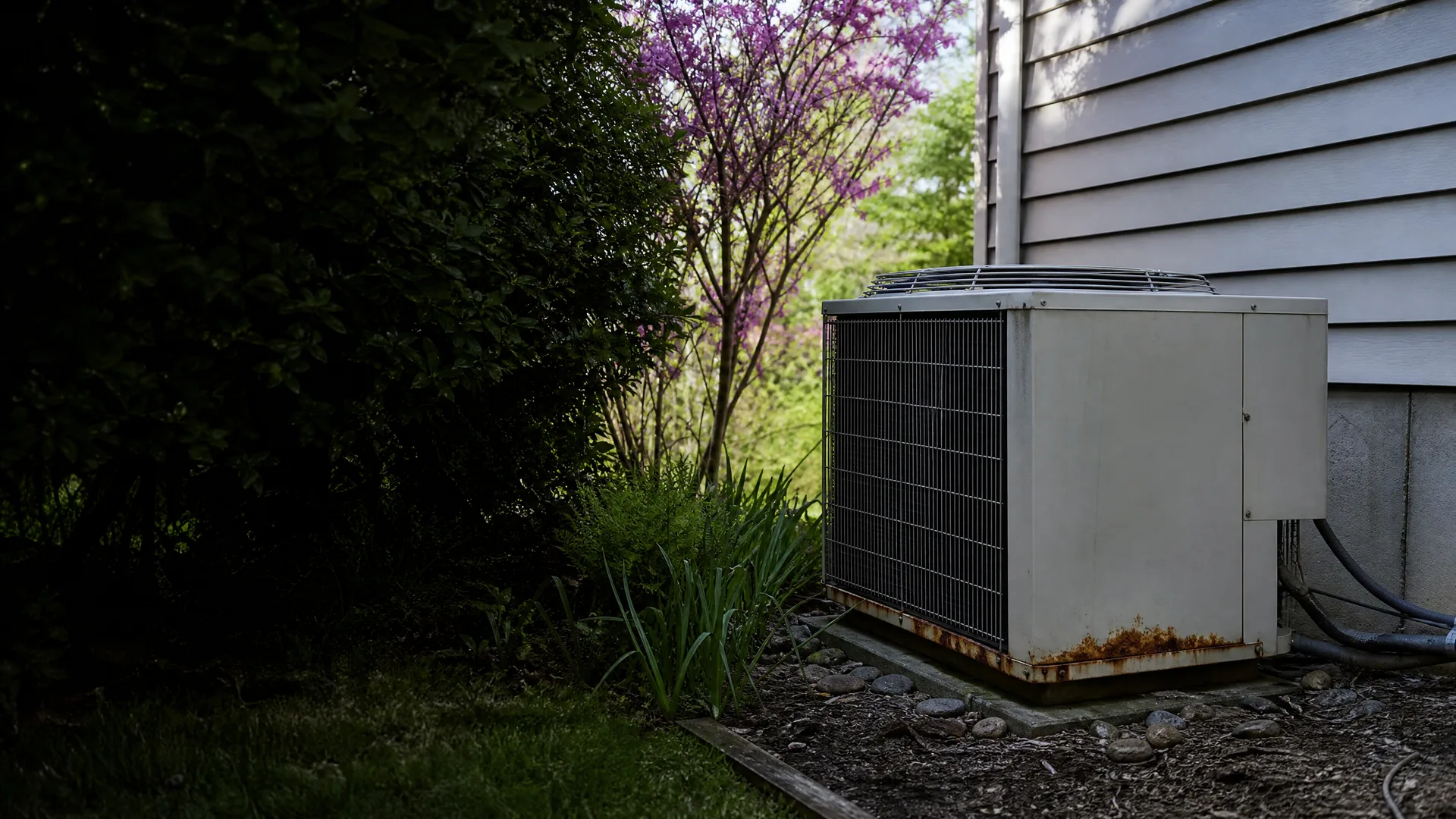
An outdoor air conditioning condenser unit with rust streaks sits on a concrete pad beside a light-colored lap-sided house, surrounded by shrubs, gravel and a flowering tree.

You're out checking the yard in April, the snow finally gone, when you walk past the heat pump and notice the rust creeping along the base of the cabinet. It's been there through sixteen North Dakota winters, you figure, sitting through every cold snap since the week it went in. The fan isn't running, the house doesn't need it this afternoon, but you crouch down and give the base a push with your boot and it gives a little. You straighten up and think about who you'd even call. The unit's old enough that it's not a question of if anymore.

No phone calls to make

A licensed installer who works in Richland County gets your project.

You're not committing to anything by asking.

A compressor rated for 15 years is an average across every climate it gets installed in, not a promise for one that runs flat out through a Richland County January.

The hours add up faster here, so a heat pump that's worked its coldest months hard for 12 years has likely used up what it had to give.

An outdoor air conditioning condenser unit on a concrete pad beside a house with horizontal siding above a brick foundation, with a flexible conduit running to a wall-mounted disconnect box.
Before you get your heat pump installation
A gray outdoor condenser unit on a concrete pad beside a beige vinyl-sided house, with a wall-mounted disconnect box, flexible conduit, mulch bed, shrubs and a concrete walkway in front.
After you get your heat pump installation

Before you get your heat pump installation

You're the one who decides when the old unit gets replaced instead of nursed through one more winter. Until then, you're watching the thermostat during cold snaps, wondering if the strips kicking on so often means the compressor is failing or just doing its job. If it quits in January, you're the one calling around Richland County looking for someone who can get out before the house drops too many degrees, explaining the rust and the short cycling to whoever picks up, then doing it again for the next company so you can compare what they tell you. Every call is another explanation of the same symptoms, another wait for someone to call back, another guess at who actually knows this equipment versus who's just available.

After you get your heat pump installation

You tell one contractor what you're seeing, once. They're local, so they've put in and serviced heat pumps through Richland County winters before and know which failures show up first in a system that's run this hard this long. No round of calls, no retelling the rust and the tripped breaker to three different voices, no sorting through quotes that all describe the job differently. You get one assessment from someone who works on this equipment every season here, and a clear answer on whether the unit in your yard is worth repairing or whether it's done. Then you're back to watching the thermostat for the house, not the compressor.

Power here costs 12.47 cents per kilowatt-hour

At 12.47 cents per kilowatt-hour, running the backup strips during a January cold snap costs less here than it would in most states. That's worth knowing when a heat pump nearing the end of its life starts leaning on those strips more often just to keep the house warm.

EIA-861 2025

Keep it running another winter

A heat pump that's heating the house and defrosting properly can still have a season or two left, even past 12 years. If the compressor isn't short cycling and the strips aren't running constantly, the unit is still doing its job. Patching a capacitor or a defrost board costs less than a new system, and plenty of units make it to 14 or 15 with that kind of upkeep. The risk is a compressor that fails on the coldest night of the year, with the house on backup strips alone until someone can get out to look at it.


Replace it before it fails

A heat pump past 12 years that's already leaning hard on the strips, icing over in defrost, or tripping breakers is closer to the end than the start. Richland County winters don't give a failing compressor an easy month to limp through. A new unit sized right for the house runs efficiently from the first cold snap, instead of burning power trying to keep up. Replacing it on your schedule, before a January breakdown forces the decision, means you're not choosing a contractor while the house is cold.

How cold does it get, and how long does the heat pump run?

  • Winter nights average 5°F

    Winter nights here average 5°F, which is exactly the point where the compressor needs backup strip heat to keep the house warm.

  • Heat runs September through May

    Nine months of heat means the compressor is working most of the year, not idling in a closet from spring to fall.

  • Cooling runs June through August

    Three months of cooling adds more run time on top of the nine months of heat, so the unit rarely gets a real rest.

NOAA nClimDiv 1991-2020

A wooden table with a closed laptop, a ceramic mug of dark coffee, and a glass vase of eucalyptus stems beside a window, with a dark green kitchen cabinet, wooden counter, potted herb, cutting boards and bowl blurred in the background.

12 to 15 years, and the winters here are the reason

A heat pump in Wahpeton runs about 12 to 15 years. You've seen why: nine months of heating, backup strips carrying the load below 5 degrees, a compressor that never really gets a rest. Past 12 years, how it's running tells you more than the number on the nameplate. Steady cycling and clean defrosts mean it still has winters left. Short cycling, ice that won't clear, or strips running nonstop mean it's closer to the end than the calendar says.

When it's time to replace rather than nurse it through another January, you don't have to spend your evenings calling around Richland County, explaining the rust on the cabinet and the short cycling to one company after another, then sitting on quotes trying to tell which one actually knows this climate. You're matched with one licensed local contractor, someone who works on heat pumps through these winters every year and knows what a system this age is likely to need. One call, one visit, and you know where you stand before the next cold snap hits.

Interior corner of a room with a dark upholstered sofa and textured cushion, a potted plant, sheer curtains at a multi-pane window showing blurred green and yellow trees, and a dark table holding a wooden tray with stacked coasters and a small ceramic vase.
A woman and a child wrapped together in a thick knitted beige blanket on a sofa, both with eyes closed, beside a lit table lamp in a dim room.
An older woman in a cream knit sweater smiles while looking off-camera in a warmly lit kitchen, with a round loaf of bread on a wooden board in the foreground and a dark window behind her.

Heat Pump Installation

One form, no calling around

One installer gets your project, so there's no bidding war over it.

A smartphone with a blank green screen stands upright against a plain light gray background.
New system or replacementHeat PumpRichland County, ND
Step 1 of 2

What ZIP code is the job in?