





A grey residential air-conditioning condenser unit mounted on a concrete pad beside a house, photographed at sunset.

Heat Pump Installation in Watford City, ND

Tell us about the job

Takes about a minute. No obligation.

New system or replacementHeat PumpMcKenzie County, ND
Step 1 of 2

What ZIP code is the job in?

Electricity heats 60.1% of homes in McKenzie County, more than any other fuel. Bottled or tank LP gas comes next at 20.1%, with utility gas at 17.4%. A heat pump fits naturally into a home already wired for electric heat, since there's no gas line to work around or replace. If your current system runs on electric resistance heat or baseboard units, a heat pump takes over that job and moves heat instead of generating it directly. For homes on LP gas, it's worth asking a contractor how a heat pump would pair with what's already there.

9 months
September through May, your system heats
2 months
July through August, it cools
7°F
the average winter night it heats against
81°F
the average summer afternoon it cools against
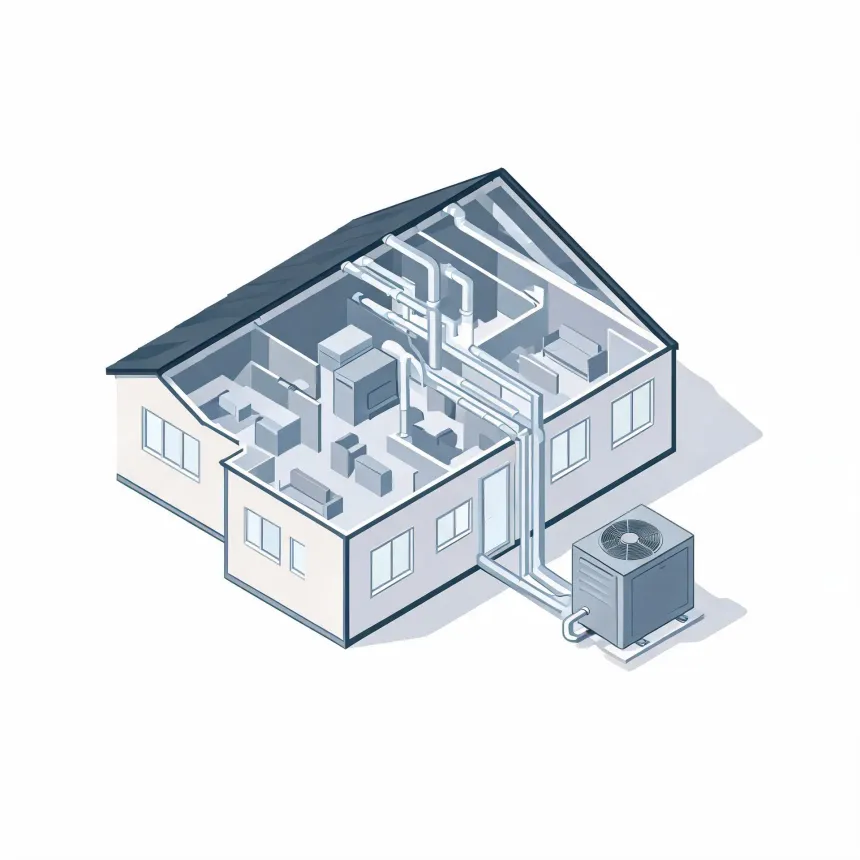
Isometric illustration of a cutaway single-story house showing interior ductwork and vents connected to an outdoor condenser unit beside the building, on a white background.
Your system heats September through May and cools July through August.

NOAA nClimDiv, 1991–2020 normals

Heat here runs September through May, nine months of the year.

Get the heat pump in before August ends, so it's proven out before that first September cold hits.

A heat pump here works through wind, hail and nights near 7 below zero

79 damaging wind events from 2015 to 2024
65 hail events from 2015 to 2024
Winter nights average 7°F
Sized right, not oversizedElectricity runs 11.51 cents per kilowatt-hour here, and a standard-size heat pump is built for that bill.

McKenzie County falls under zone 6A, a cold climate zone with winters that run long. Any split-system heat pump installed here has to meet a federal minimum tied to that rating. It needs to hit at least 14.3 SEER2 for cooling and 7.5 HSPF2 for heating. That rules out older or cheaper models that fall below those numbers. A contractor sizing a system for this area has to work within that floor, not below it.

Get the sizing right before the first cold night

Wind, hail and nights near 7 below zero put more hours on a heat pump here than it sees in most places. That is a reason to get the sizing right, matched to this house, not to whichever bid is lowest. A system sized correctly from the start holds up better to what this place throws at it.

Find a contractor
A gray heat pump outdoor unit mounted on a concrete pad next to a residential house with lap siding and stone accents.

The number on the label is a season's average, not a guarantee

The SEER2 number tells you how much cooling the unit gets out of the electricity it uses, averaged over a season of starts and stops, not a single moment of peak output. The HSPF2 number does the same job for heating. A higher rating means the compressor and the coil are doing more with less, but it does not mean the unit is bigger or stronger. A high-rated unit sized wrong for the house will still run poorly. The rating also assumes the system is installed and maintained the way it is meant to be. A dirty filter, a low refrigerant charge, or a coil caked with dust will pull real-world performance below what the label promises, no matter how high the number is. That gap only grows over the life of the system if the unit never gets serviced.

Ask what happens below freezing

A heat pump loses capacity as the outdoor temperature drops, and every manufacturer builds in a point where the compressor needs backup heat to keep up. Ask what that backup source is, whether it's a heat strip or something else, and at what outdoor temperature it kicks in. That answer tells you how the system actually behaves on the coldest night of the year, not just on a mild one.
Ask who sized the system and how

Sizing a heat pump off square footage alone misses the insulation, the windows, and the duct layout, all of which change how much heat a house actually loses. A contractor should walk the house or ask about it in detail before naming a size. If a quote comes back fast with no questions about the house itself, that's worth asking about directly.

Installed cost comes down to what the crew has to do beyond setting the unit outside. If the home already has ductwork that's sized right and in good shape, the job is mostly connecting to what's there. If the ducts are undersized, leaky, or missing in part of the house, that work gets added in, and it adds real labor. The electrical panel matters too. A heat pump draws more power than a gas furnace did, and some panels need upgrading to carry that load before the system goes in. Line length and placement matter as well, since running refrigerant line further from the outdoor unit to the air handler means more material and more time. None of this shows up in the sticker price of the equipment itself, but it shows up in the bid.

If the old system is a furnace paired with central air, both parts usually come out, since the heat pump takes over everything the furnace did plus the AC's job in one unit. If the house heats with electric resistance or baseboard units, those often stay in place as backup rather than getting hauled away, wired to kick in only if the heat pump can't keep up. A gas furnace getting replaced needs its gas line capped off properly, not just disconnected, and that's a job for whoever handles the gas work, not left as an afterthought. The outdoor condenser or compressor from the old AC comes out regardless, since the new heat pump brings its own. Whatever gets removed, ask the contractor directly what happens to it and whether disposal is part of the job or an extra line item.