Profile view of a bearded man wearing a black baseball cap and a dark gray T-shirt against a plain light background.

Repair or replace a gas furnace in Minot, ND

New system or replacementFurnace or heatingWard County, ND
Step 1 of 2

What ZIP code is the job in?

Should I repair or replace my gas furnace in Minot?

Your furnace is giving you trouble and you're trying to figure out whether it's worth fixing or if you should just replace it. In Minot, winters get down well below zero for weeks at a time, and a furnace that quits isn't something you can put off. You want to know what actually makes sense before you spend money on a repair that might not hold.

Repair it if it's younger than 15 years and the fix is minor. Replace it if it's older or the repair is major.

A furnace much past 15 years has usually put in enough winters that its heat exchanger and other major parts are closer to the end than the start. If yours is older than that and the repair involves the heat exchanger, the blower motor or the control board, the cost of fixing it starts to compete with what a new unit would run. If it's younger and the problem is something smaller, like an igniter or a flame sensor, repair is the better call. In Ward County, where most homes run on gas and a hard winter asks a lot of the furnace, a unit on its last legs is a risk you feel the first cold snap it fails.

A beige furnace with a louvered front panel and metal ductwork stands on a concrete basement floor beside pipes and a white cylindrical water heater.
Before you get your furnace installation
A gray high-efficiency furnace in a basement with PVC venting pipes, a yellow gas line, metal ductwork, concrete walls and floor, and a wood-framed stairway at left.
After you get your furnace installation

Is your furnace actually telling you something?

You might hear it kick on and off more than it used to, or run longer to get the house to temperature. Some rooms feel colder than others. The burner flame looks more orange than blue, or you smell something faint when it starts up. Maybe it's making a noise it didn't make last winter, a bang or a rattle from the cabinet. The pilot or igniter takes a few tries to catch. None of this is nothing. A furnace in Ward County carries the house through weeks of weather well below zero, and a unit that's struggling now on a mild day won't hold up when it has to run nonstop. Left alone, a weak furnace means higher bills, cold rooms that stay cold, and a harder time getting anyone out when it finally quits in the middle of a cold snap.

A man with grey hair and stubble in a dark sweater sits on a grey sofa indoors, looking off to the side, with a potted plant and a sunlit window behind him.
A man with gray hair, a beard and glasses, wearing a dark green sweater, sits on a gray sofa in a sunlit living room with a potted plant, table lamp and wooden sideboard behind him.
A middle-aged man with graying hair and a short beard sits on a blue sofa in a living room, looking toward a window, with a bookshelf, lamp and framed picture in the background.
A man with graying curly hair and a dark green sweater sits on a gray sofa in a sunlit living room, looking off to the side, with a framed picture, shelving, an armchair and a window with sheer curtains behind him.

Repair the Furnace or Replace It

Repair

  • A cracked heat exchanger can't be patched, and it's the one failure that usually ends the conversation about repair.
  • An igniter or flame sensor is a straightforward swap, and most furnaces run another winter or more after it.
  • A draft inducer motor or control board runs into real money, and on an older furnace that bill competes with a new one.
  • If the furnace is still under its original parts warranty, repair costs less out of pocket than it would otherwise.
  • A furnace that's been reliable until now and just hit one failure is usually worth fixing rather than replacing.
  • Repair keeps you on the same equipment, so there's no sizing or ductwork question to work through.

Replace

  • A furnace that's lasted through many Minot winters already and is now failing in more than one way is past the point of chasing repairs.
  • A new furnace is built to a higher efficiency rating, and with gas prices here that lower bill adds up over a hard winter.
  • Replacement resets the clock, so you're not back in this same decision two years from now with a different part failed.
  • If the furnace struggles to keep the house even at 20 below, a repair won't fix a unit that's undersized or worn past its output.
  • A new installation needs the furnace sized to your house and ductwork checked, not just the old unit swapped out.
  • Once repair costs start approaching what a new furnace runs, you're paying twice toward the same outcome.
A gray residential furnace with two panel doors stands against a plain light wall in a concrete-floored room, connected to metal ductwork and white and copper pipes.

Cold snaps find the weak part

Ward County winters sit below zero for stretches, and a furnace runs close to nonstop through those weeks. That kind of runtime is what finds a cracked heat exchanger or a tired draft inducer motor before you'd otherwise notice. A furnace that's been limping along in October can fail outright once it has to carry a house through a week of real cold. Age matters here more than it would somewhere milder, since the equipment gets worked harder for longer.

A gray high-efficiency furnace with white PVC venting pipes stands against a plain wall in a basement, connected to sheet-metal ductwork on a concrete floor.

Gas heat, cheap power

Most houses around Minot heat with gas, and electricity here costs less than in a lot of places, which changes the math on repair versus replace. The blower motor, the igniter, the control board, all of it runs on electricity even in a gas furnace, so a newer unit's efficiency gains show up on the power side too. A furnace replacement here is sized around gas heat output and the electrical draw of its components, not around one or the other alone.

A man seen from behind raises his hand to wave at a woman standing in the open front doorway of a single-story house with gray shingle siding, white columns and a gabled porch entry.

What actually happens when the furnace fires

The thermostat calls for heat, and the draft inducer motor spins up first, clearing the exhaust path before anything lights. A pressure switch checks that the inducer is actually moving air before it lets the igniter glow. Once the igniter's hot enough, gas opens to the burners, and the flame sensor confirms a flame is really there. If any of those steps fails to report back, the furnace shuts itself down rather than run blind. That's why a bad pressure switch or a weak flame sensor signal can look like "the furnace won't start" when the real problem is upstream of the burner entirely.

Knowing that order matters when someone's diagnosing your furnace, because a tech who understands the sequence can usually tell you which part failed before they've pulled the panel off. A local contractor who works on these furnaces through a full Ward County winter has seen most of what fails and where. When you're matched with one, it's a single contractor reaching out, not several, and one who already knows what a hard winter here does to an inducer motor or a pressure switch.

A gray upholstered sofa with a textured cushion sits beside a dark round side table holding a vase of green foliage, with a table lamp and sheer-curtained window behind.
A gray high-efficiency furnace stands on a concrete basement floor beside galvanized sheet-metal ductwork, with white PVC vent pipes, gas and water lines, and unfinished wood framing behind it.

Furnace running clean

This is what a furnace should look like after a repair or a new install. The burner lights on the first call, the flue pipes run tight, and the blower pushes air through the ducts without strain. Nothing around it, the gas line, the wiring, the ductwork, needs to fight the furnace to keep the house warm through a Ward County winter.


A beige furnace with two louvered front panels stands on a concrete basement floor beside galvanized ductwork, metal pipes, and a wooden post.

Furnace in trouble

Same kind of setup, different story. A furnace like this might be short-cycling, struggling to hold a flame, or leaking a smell you've noticed near the gas line. Once a part like the heat exchanger or the draft inducer motor starts failing, the furnace around it still looks fine, but it's not getting through the cold stretch without help.

A woman with shoulder-length brown hair wearing a beige knit cardigan sits in a gray upholstered armchair near a window, looking off to the side with a slight smile, with bookshelves blurred in the background.
A woman and a sleeping child wrapped together in a cream knitted blanket on a couch, with a potted plant, framed photo and lit lamp in the background.

Get matched with a furnace pro in Ward County

Your request goes to one pro, not a list of companies.

Sending the form costs nothing.

A gray high-efficiency furnace in a basement with white PVC vent pipes, sheet-metal ductwork, copper and black piping, a condensate pump, and insulated walls above a concrete floor.
A furnace like this fires clean, drains through the PVC line without pooling, and moves air through tight, sealed duct runs.
A beige residential furnace stands on a concrete basement floor beside galvanized sheet-metal ductwork, a round flue pipe, copper gas piping, and a PVC condensate line, with a wood-paneled wall at right.
An older furnace like this, fed by iron pipe and venting through a metal flue into a masonry chimney, is the kind that starts needing judgment calls.
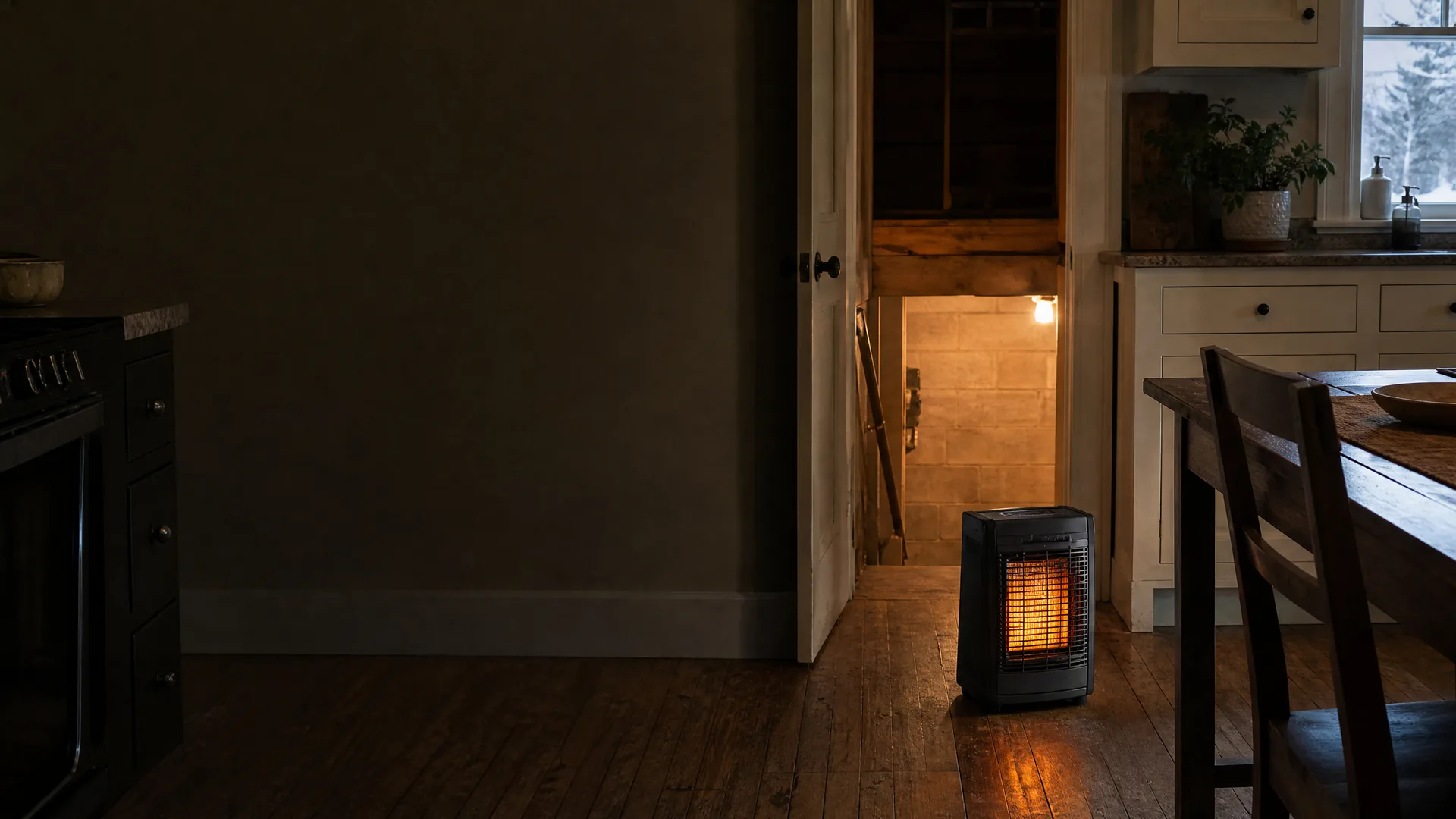
A dimly lit interior with wood plank flooring where a small portable heater with a glowing orange element sits near an open doorway, with a stove at left, kitchen cabinets and a potted plant at right, and a wooden table and chair in the foreground.

The furnace gave out sometime after midnight, and by six the house was down to fifty. You pulled the space heater up from the basement and set it by the kitchen table, and now it's the only warm spot in the room. Outside it's still dark and the wind's been at the siding since four. The basement door stands open behind it, the stairs dropping into a cold you can feel from the table. Your coffee's going lukewarm fast. You're doing the math on how long three of you can live out of one orange glow before someone needs a shower and the bathroom's worse than this.

Winter nights average 5°F

At 5°F, a furnace that short cycles or limps along on a weak igniter is working harder to begin with. A marginal part that held on in October usually won't make it through a night like that, and that's when a repair call turns into an overnight no-heat call.

NOAA nClimDiv 1991-2020

A furnace that's failing doesn't wait for a convenient week to quit. If it goes out on a night when it's below zero, you've got pipes to worry about along with the cold. Water lines run through walls and a basement that's unheated for even a day in that kind of weather can freeze. A space heater or two will keep one room livable, but it won't carry a Ward County house through a January night, and your power bill will show it if you try. There's also what you're breathing: a cracked heat exchanger can let exhaust mix into the air moving through your ducts, and you wouldn't necessarily smell it. None of this means every rattle or long run cycle is an emergency. It means the furnace that's limping along in October is the one you want looked at before the first real cold snap, not after your house has already dropped ten or fifteen degrees overnight.

How cold does it get, and how long does the furnace run?

  • Winter nights average 5°F

    Winter nights average 5°F. That's the overnight low across December, January and February, and it's what your furnace is up against most of the night, not just on the worst ones.

  • Heat runs September through May

    Heat runs September through May. Nine months a year, which is most of the year your furnace is the thing standing between you and the cold outside.

  • 56.7% of homes heat with gas

    56.7% of homes here heat with gas. That means parts, service and know-how for gas furnaces are common in Ward County, not a specialty call.

NOAA nClimDiv 1991-2020 · ACS 2020-2024

Repair or replace, decided right

  • A cracked heat exchanger or a furnace older than its expected life is a replace, a bad igniter or flame sensor is a repair.
  • Ward County winters average 5°F overnight from December through February, so the decision is worth getting right before the next cold stretch.
  • A furnace that's marginal in October is the one that fails on a night well below zero, often with no warning.
  • Matching you with one licensed local contractor means a single point of contact who knows what tends to fail on furnaces in this area.
  • That contractor looks at your specific furnace and your situation, not a general rule, before telling you which way to go.
  • Either way, the goal is the same: a furnace that fires clean and keeps the house warm through the rest of the winter.

A furnace either has a part worth fixing or it doesn't. A heat exchanger that's cracked, or a unit that's already past the years it's built to run, points to replacing it. An igniter or a flame sensor is a repair, and a furnace with one of those swapped out usually runs fine the rest of the winter. The hard part isn't knowing those two ends of it. It's the furnace in between, the one that's still running but not quite right, and whether it's got another winter in it or not.

That's where having someone local who works on these furnaces all season matters. A contractor who's out on these calls through December, January and February has seen which parts give out first in this weather and which ones hold up. They're not guessing from a chart. They're looking at your furnace, how old it is, what's already failed on it, and what it's been asked to do on nights at 5 degrees, and telling you honestly which way to go.

When you ask to get matched, it's one contractor, licensed and local, not a handful of companies competing for the callback. That contractor looks at your specific situation instead of applying a blanket rule to it. Whether the answer turns out to be a repair or a new furnace, the point of getting this right is the same: heat that keeps running through the rest of the cold months, without another failure you didn't see coming.

Kitchen corner with cream upper cabinets, oak lower cabinets, white marble-look countertop, beige tile backsplash, a ceramic vase of greenery, a wooden cutting board and bowl, and a black-framed window at right.
Interior corner of a room with a white-framed window and wide sill, beige walls with panel molding, a wooden cabinet holding a ceramic vase with a green leafy plant, and blurred shrubs and trees outside.
A wood-framed armchair with beige cushions and a woven lumbar pillow sits in a corner beside a large window overlooking green trees, with a tall ceramic vase holding leafy branches on the left and plaster walls and wood flooring.
Interior corner with a white-framed window above a sill, beige walls with baseboard molding, a greige shaker-style cabinet with brass knobs and a potted plant on top, light wood flooring and a woven jute rug.
A dark-framed six-pane window with white trim and sill set in gray horizontal lap siding, with hydrangea shrubs below and a white column and shingled roof section at left.

A local pro for your furnace installation

The pro who gets in touch is licensed in North Dakota and works in Ward County.

Get a local pro

You're not committing to anything by asking.