A snow-covered suburban street at dusk with lit houses and bare trees under a twilight sky.

Heat Pump Repair in Mohall, ND

Tell us about the job

Takes about a minute. No obligation.

RepairHeat PumpRenville County, ND
Step 1 of 2

What ZIP code is the job in?

Ice and snow load the system twice a day

Renville County logged 25 winter storms between 2015 and 2024, counting heavy snow, ice and blizzards. Every one of those means the outdoor unit is cycling through defrost, pulling heat from air that's already fighting it. That's strain a heat pump in a milder state never has to deal with.

Hail adds a second kind of wear

The county recorded 33 hail events between 2015 and 2024. The outdoor coil and fan sit exposed to that. A dented coil or a bent fan blade from one storm can turn into a refrigerant leak or a noisy motor months later, long after the storm is forgotten.

9 months
September through May, your system heats
2 months
July through August, it cools
3°F
the average winter night it heats against
79°F
the average summer afternoon it cools against
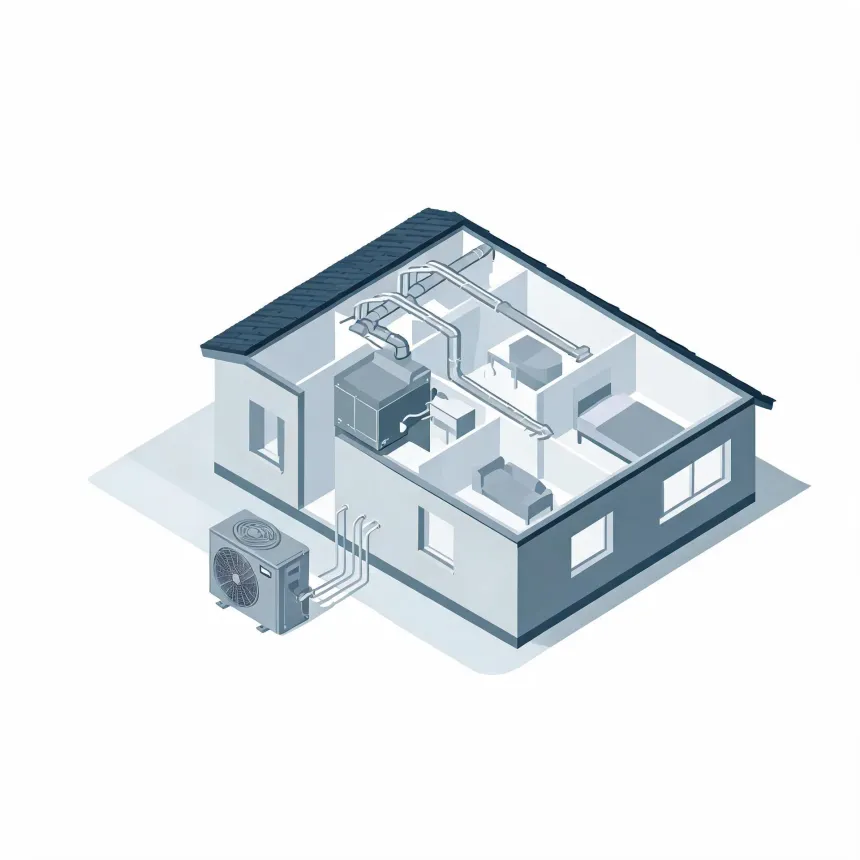
Isometric cutaway illustration of a single-story house showing interior rooms with ductwork, an indoor air handler unit, and an outdoor condenser unit connected by lines along the exterior wall.
Your system heats September through May and cools July through August.

NOAA nClimDiv, 1991–2020 normals

Electricity here runs 10.72 cents a kilowatt-hour, cheaper than most of the country.

A heat pump losing efficiency still pulls more power to do the same job, and that shows up on the bill even at a low rate.

Half the homes here were built before your heat pump's time

Half the homes here were built by 1973
Climate zone 7
Power here costs 10.72 cents per kilowatt-hour

Heat here starts in September, and the first cold snap is when a weak part usually gives out. A heat pump that limped through a mild September gets asked for a lot more once nights drop toward that 3°F average in December and January. If the defrost cycle was already struggling, or the contactor was already pitted, that's when it quits instead of just running rough. Getting it looked at in August, before the switch to heat, catches that part while it's still a repair and not a no-heat call in January.

Whatever's wrong, something here has been working harder than it should

That dent in the coil or the pitting on a contactor doesn't announce itself. It just makes the unit work harder until something gives out. A proper diagnosis finds the part that storm damage or defrost cycling already weakened, before it's the reason you have no heat.

Find a contractor
A gray air-source heat pump mounted on a concrete pad next to a house with gray vinyl siding, surrounded by gravel and flanked by green shrubs and white hydrangea flowers.

Running it while it's failing

A heat pump that's losing its charge or running a weak contactor doesn't fail the moment that part goes bad. It fails after that part has been dragging the rest of the system along with it. A low refrigerant charge makes the compressor work harder to move the same heat, and a compressor that runs hot for weeks wears faster than one that was fixed at the first sign of trouble. A reversing valve that's starting to stick will keep switching, just roughly, right up until the day it doesn't switch at all. Running the system through that instead of shutting it down for a repair asks the next part in line, the compressor, the motor, the board, to cover for the one that's already failing. That's how a bad capacitor turns into a bad compressor. The capacitor was the cheap part. The compressor isn't.

What you can check yourself

Look at the outdoor unit first. If it's buried in snow or ice is bridging the fins, clear it by hand, don't chip at the coil. Check that the indoor filter isn't clogged, a dirty filter starves airflow and can make the whole system struggle. Walk around inside and check that every vent is open and nothing's blocking the return. Look at the thermostat battery if it has one, and make sure it's set to heat, not cooling or fan only. None of this fixes a bad part, but it rules out the easy stuff before anyone comes out.

What tells you to stop and call

If the outdoor fan isn't spinning at all, or it's spinning but the unit is making a grinding or clicking noise, that's not something to keep running. Ice building up on the coil that doesn't clear during a normal defrost cycle means something in that cycle has failed. Warm air that isn't actually warm, or air that smells burnt, both mean stop and get it looked at instead of waiting to see if it clears up on its own.

Most heat pump calls start with one of a few complaints. The system runs constantly but the house never quite gets to temperature. Air comes out of the vents barely warm, like it's not trying. The outdoor unit makes a hard clunk when it starts, or a steady rattle that wasn't there before. Sometimes it short cycles, kicking on and off every few minutes instead of running a normal stretch. Any of those point to a specific failure, a low refrigerant charge, a failing reversing valve, a capacitor that's lost its charge, and none of them get better by waiting. A system straining to do its job now is a system more likely to fail outright later, usually at the worst time.

A heat pump pulling more power than it should keeps doing that every day nobody looks at it. The repair doesn't get cheaper by putting it off. What changes is how many weeks you pay the higher bill before it's fixed. A weak capacitor or a failing reversing valve doesn't correct itself, it just keeps drawing power to cover for whatever's wrong, right up until it quits. Calling now stops that instead of letting it run through another month on the meter.