






A snow-covered small-town street at dusk, with lit white clapboard houses, bare trees, and a grain elevator silhouetted against an orange and blue twilight sky.

Heat Pump Repair in Garrison, ND

Tell us about the job

Takes about a minute. No obligation.

RepairHeat PumpMcLean County, ND
Step 1 of 2

What ZIP code is the job in?

A heat pump in McLean County earns its keep. Zone 6A means a long heating season, and the unit is pulling double duty, keeping the house warm for months and then switching over to cool it. Winter storms hit this county 27 times between 2015 and 2024, and that's 27 chances for ice and heavy snow to load up the outdoor unit while it's trying to run. Hail has come through 57 times in that same stretch, and wind strong enough to cause damage hit 88 times. None of that is rare weather here. It's the normal workload for the equipment outside your house, and it adds up faster than people expect. When a part finally gives out, it's usually because it was worked harder than a heat pump in a milder county ever gets worked.

9 months
September through May, your system heats
2 months
July through August, it cools
5°F
the average winter night it heats against
79°F
the average summer afternoon it cools against
Isometric cutaway illustration of a single-story house showing interior rooms, attic ductwork and an air handler, with an outdoor condenser unit connected by lines along the exterior wall.
Your system heats September through May and cools July through August.

NOAA nClimDiv, 1991–2020 normals

Heat here starts in September, but May and even August nights can still call for it.

A heat pump that limped through winter on a weak part usually fails the first cold morning it has to work hard again.

Electricity here runs 11.84 cents a kilowatt-hour, and a struggling heat pump burns through it every month it goes unfixed

Power here costs 11.84 cents per kilowatt-hour
Climate zone 6A
Cooling runs July through August

A heat pump that's short on refrigerant or running on a weak capacitor doesn't just work worse, it runs longer to make up for it. That's more hours pulling power every day it sits unrepaired, and power here isn't the kind of cheap that makes you forget it's running. Waiting through another cold stretch to see if it sorts itself out usually just adds to the bill without fixing anything. Garrison winters don't let up long enough for that gamble to pay off. Getting a contractor out to look at it now costs less than another month of it struggling.

Your heat pump has been working harder than most. That's usually why it's struggling now.

Whatever's outside your house has been working through the kind of weather that wears parts down faster than it would somewhere calmer. A part that's finally failing is rarely a fluke. Have it looked at and diagnosed properly, so whatever gets fixed actually holds.

Find a contractor
A man in a cap, dark shirt and tan work pants carries a worn canvas tool bag up porch steps toward a dark blue front door, with a potted shrub beside the entry.
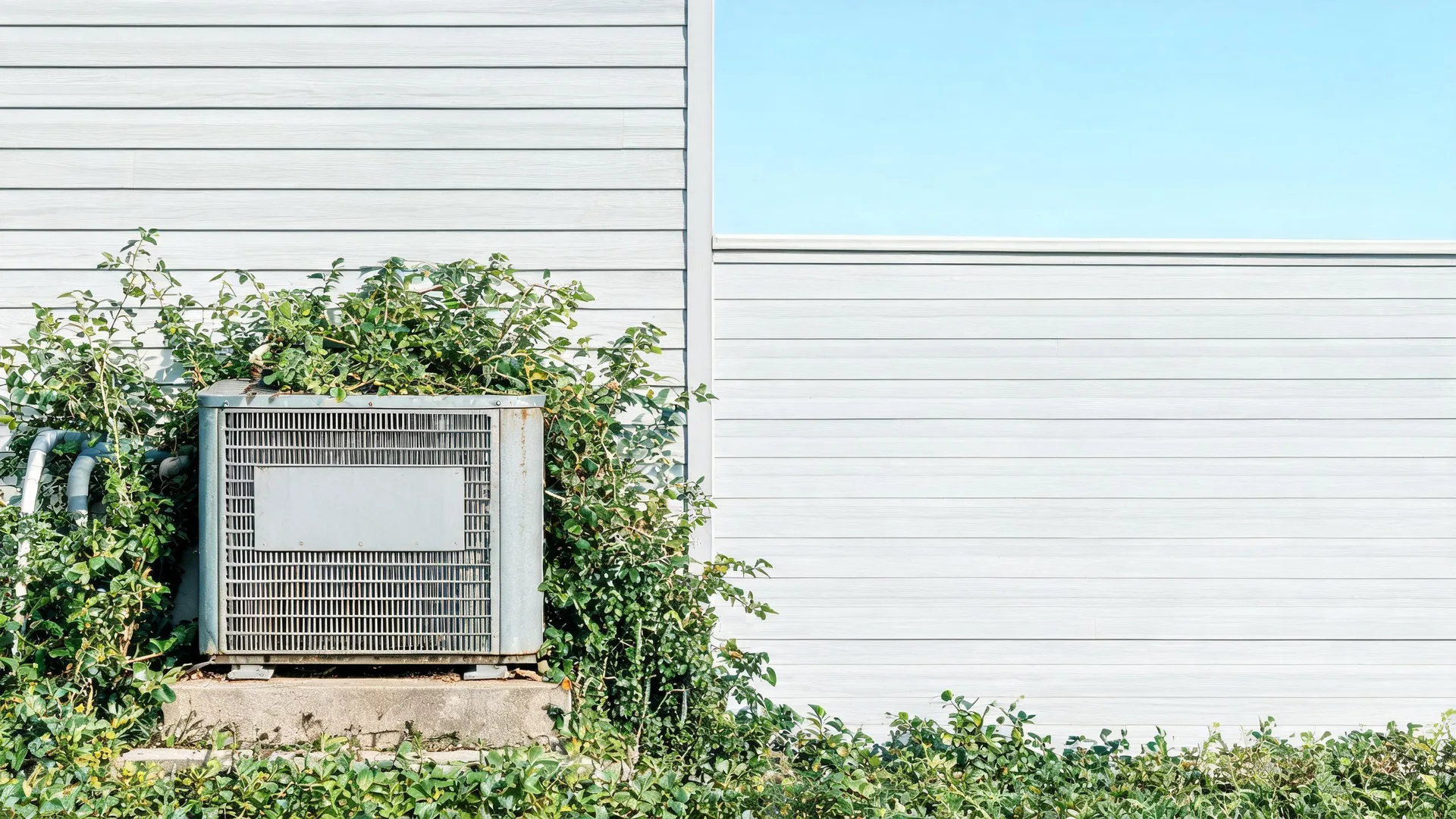
A gray heat pump condenser unit mounted on a concrete pad against the gray lap-siding exterior wall of a house.

What You Can Check Before the Tech Gets There

Before anyone comes out, there are a few things worth checking yourself. Look at the outdoor unit first. If it's covered in ice, caked with snow, or packed with leaves and debris, clearing that away sometimes gets it running again on its own. Check the air filter next. A filter clogged with dust chokes off airflow, and a heat pump starved for airflow will run constantly without keeping up. Walk around the house and check every vent is open and nothing is sitting in front of a return. Look at the thermostat. A dead battery or a setting bumped to the wrong mode will make a perfectly good system sit idle. Check the breaker panel too. A heat pump trips a breaker sometimes without anything being wrong with the unit itself, and resetting it is enough. If you hear the outdoor unit humming but the fan isn't turning, or it's making a hard clicking sound trying to start, turn it off at the thermostat and leave it off. Running a motor that can't start usually burns it out for good. The same goes for ice that keeps coming back within a day of clearing it. That's not a one-time fix, that's a sign something inside needs a real diagnosis.

It won't switch into defrost right

A heat pump in heating mode should clear frost off the outdoor coil on its own every so often, running the fan loud and sometimes puffing steam while it does. If the coil stays white or gray with a solid layer of ice instead, the reversing valve or the defrost control isn't doing its job, and the unit will keep losing heating capacity until it's barely moving warm air.
It runs long and still falls short

A heat pump short on refrigerant or losing its grip on airflow doesn't shut off when it should. It keeps running, the air coming out of the vents feels lukewarm instead of warm, and the house never quite catches up to the thermostat setting. That long runtime is the compressor and fan straining to make up for a problem somewhere else in the system, not the system doing its normal job.

A heat pump that's struggling rarely fixes itself by running more. A compressor low on refrigerant works harder to move the same heat, and that extra strain is what finally cracks a weak solder joint or burns out a motor winding that would have lasted years otherwise. Ice left to build on the outdoor coil blocks airflow across it, so the system pulls in less heat each cycle and runs longer to compensate, which only feeds more frost back onto the coil. A failing capacitor makes the compressor or fan motor draw more current than it should every time it tries to start, and each hard start wears it down a little more until it doesn't start at all. None of these get better with time. They get worse the longer the system keeps trying to work around them, and what would have been a simple part swap turns into a compressor replacement.

A diagnostic call starts outside at the unit itself, not inside with the thermostat. A tech checks the refrigerant charge with gauges, because a system low on refrigerant looks fine sitting there but can't move heat the way it should. They'll pull the access panel and test the capacitor and the contactor, since both wear out from ordinary use and both cause a compressor or fan that hums without turning. Airflow gets checked too, across the indoor coil and the outdoor coil, because a unit starved for airflow on either side runs long and still can't keep up. If the system won't switch properly between heating and defrost, the reversing valve gets tested directly rather than guessed at. The point of all this is to find the one part actually causing the problem, not to start swapping parts and see what helps.