






A gray outdoor HVAC condenser unit mounted on a concrete pad in the front yard of a two-story suburban house.

Heat Pump Repair in Watford City, ND

Tell us about the job

Takes about a minute. No obligation.

RepairHeat PumpMcKenzie County, ND
Step 1 of 2

What ZIP code is the job in?

McKenzie County sits in zone 6A, a cold climate with a long heating season, which means a heat pump here runs through most of the year instead of catching a break in milder months. The outdoor unit takes the weather too. McKenzie County has seen 79 damaging wind events and 65 hail events between 2015 and 2024, and the coils and fan sit outside for all of it. Add 16 winter storms in that same stretch, snow and ice piling around a unit that still has to keep running. A system working that hard wears sooner than one that only has to get through a mild season. When it starts acting up, the cause is usually tied to that load, not a one-off defect, and a proper diagnosis should start there.

9 months
September through May, your system heats
2 months
July through August, it cools
7°F
the average winter night it heats against
81°F
the average summer afternoon it cools against
Isometric cutaway illustration of a single-story house showing interior rooms, attic ductwork and an air handler, with an outdoor condenser unit connected by lines along the exterior wall.
Your system heats September through May and cools July through August.

NOAA nClimDiv, 1991–2020 normals

Electricity here runs 9.60 cents a kilowatt-hour, cheaper than most of the country.

A heat pump running wrong still pulls power the whole time it struggles, every day it sits unrepaired.

A newer house usually means a newer heat pump, and that's worth checking before you assume the worst

Half the homes here were built by 2011
Climate zone 6A
Power here costs 9.60 cents per kilowatt-hour
Nine months of heat, starting in SeptemberAugust is the month to get a heat pump checked before it has to carry the cold.

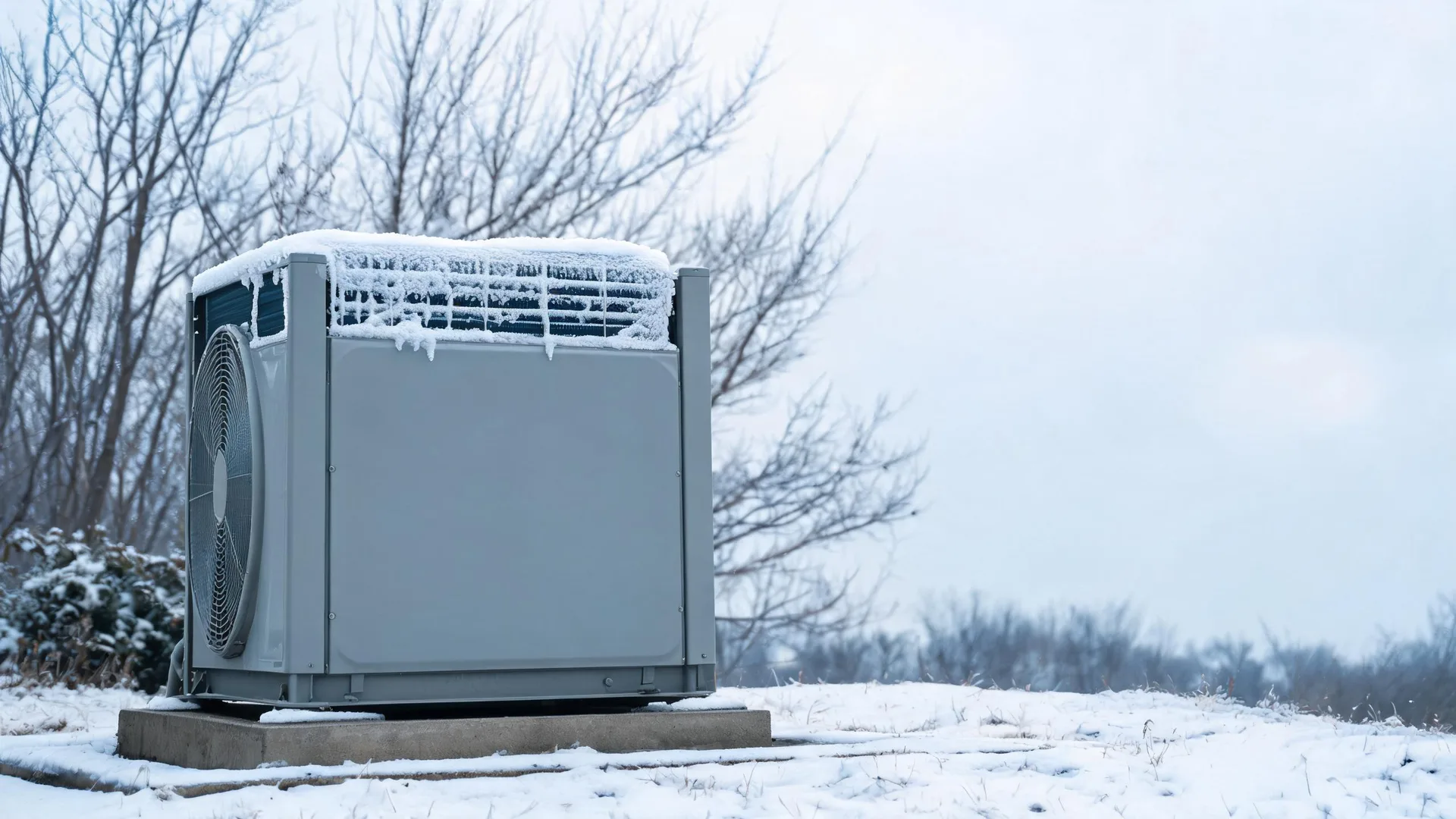
A heat pump that keeps running with a problem rarely stays a small problem. Ice is the clearest case. Once frost gets ahead of the defrost cycle, it builds on the outdoor coil fast, and a thin layer that would have melted off on the next cycle turns into a block that chokes off airflow entirely. A low refrigerant charge works the same way. The compressor still runs, but it runs hotter and longer to move the same heat, and compressors are not built to take that for long. A failing capacitor is worse to ignore than it looks, because a motor that struggles to start draws a hard pull of current every single time, and that wears the windings down well before the capacitor itself finally gives out. Airflow problems compound everything else. A system straining against a dirty coil or a blocked return runs longer to hit the same setpoint, and that extra runtime is what turns a part that was merely weak into one that fails outright. Shutting the system off at the first sign of grinding, screeching, or short cycling costs nothing and often saves the compressor, which is the one part worth protecting above all the rest.

Have it diagnosed, not just patched

The load on this unit does not let up, and that is usually what is sitting behind whatever it is doing right now. A proper diagnosis traces the problem back to what is actually straining it, so the fix holds instead of calling someone back out in a month.

Find a contractor
A dark gray heat pump unit mounted on a concrete pad next to a house with gray siding and a stone veneer wall.

Know the age before you decide what it's worth fixing

If your heat pump came with the house, check when that was. A system installed within the last several years still has most of its working life ahead, and a repair now is the right call, not a stopgap before a bigger expense. Mobile homes are a bigger share of the housing stock here than in most counties, and a unit serving one of those should get the same look. Age is the first thing worth knowing before anyone decides what a repair is really worth.

What you can check safely

Look at the outdoor unit first. If snow or ice has built up around the base or the coil is packed, that alone can stop a heat pump cold. Clear what you can reach by hand, never with a shovel or anything sharp against the coil fins. Check the air filter inside. A clogged filter starves the system of airflow and can make it ice up or short cycle. While you're at the thermostat, confirm it's set to heat and the setpoint is actually above room temperature, it sounds obvious until it's the whole problem. Walk the vents and make sure none are blocked by furniture or closed off.
What to leave alone

Don't open the outdoor unit's cabinet or touch the wiring behind it. Don't pour hot water on an iced-up coil, it can crack the fins or the pan underneath. If the system is making a grinding or screeching noise, or tripping the breaker when it starts, shut it off at the thermostat and leave it off. Running a failing compressor or motor often turns a repair into a replacement. If the unit is blowing cold air during a heat call and none of the simple checks fix it, that points to something in the refrigerant circuit or the reversing valve, and that's diagnostic work, not a homeowner fix.

Most heat pump failures trace back to a handful of parts that do the hardest work. The reversing valve is a common one. It's what switches the system between heating and cooling, and after enough cycles the valve can stick, leaving the unit stuck in one mode or blowing air that's not warm enough. The defrost control board is another. It tells the unit when to melt off the frost that builds on the outdoor coil, and when it fails, ice just keeps building until airflow stops. Capacitors wear out too, the small part that gets the compressor and fan motors started, and a weak one shows up as a unit that hums but won't kick on. The compressor itself is the part nobody wants to hear about, since it's the heart of the system, and a failing one is often a replacement rather than a repair. Dirty coils and starved airflow make all of this worse, because a system straining to move heat runs longer and harder than it should, and that shortens the life of everything else in it.

A diagnostic visit starts outside, at the unit itself. A tech checks refrigerant pressure, since too little or too much changes everything downstream, from how warm the air feels at the vents to how hard the compressor has to work. From there it's electrical readings, the capacitor, the contactor, the wiring to the outdoor fan motor, looking for the part that's drawing wrong or not drawing at all. Inside, the tech checks airflow at the return and the supply side, because a system can have a good compressor and still perform poorly if air isn't moving through it right. The defrost board gets checked too, since a bad sensor or a stuck relay there can leave a unit icing up even when everything else is fine. None of this is guesswork. Each reading either rules something out or points straight at what's failing.