





A chain-link fence runs along the left edge of a large mown lawn, with a row of one- and two-story houses with gray and white siding in the background under an overcast sky, framed by overhanging tree branches.

Heat Pump Repair in Grafton, ND

Tell us about the job

Takes about a minute. No obligation.

RepairHeat PumpWalsh County, ND
Step 1 of 2

What ZIP code is the job in?

Winter storms hit Walsh County 102 times between 2015 and 2024, and damaging wind another 71 times. A heat pump outside takes that straight on, through the coil, the fan, the cabinet. Every one of those events is a stretch where the system has to keep pulling heat out of cold air while ice and wind work on the unit itself. That kind of load adds up on the parts outside faster than it would somewhere calmer. When a heat pump here starts acting up, that wear is usually part of the story, and it is worth finding out which part gave out first.

9 months
September through May, your system heats
2 months
July through August, it cools
1°F
the average winter night it heats against
78°F
the average summer afternoon it cools against
Isometric line illustration of a cutaway house showing interior rooms with furniture, a furnace or air handler with overhead ductwork, and an outdoor condenser unit connected by lines outside the wall.
Your system heats September through May and cools July through August.

NOAA nClimDiv, 1991–2020 normals

Half the homes in Walsh County were built in 1971 or earlier.

A heat pump that came with a house that age is closer to the end of its working life than the start.

Nine months of heat a year means this machine barely gets a break

Cooling runs July through August
Heat runs September through May
Climate zone 7
Power here is cheap, but a struggling heat pump still runs up the billWalsh County homes paid 12.21 cents per kilowatt-hour in 2025, lower than most of the country, which is exactly why a bad month on this bill means the unit is working harder than it should.

If your heat pump is original to a house from that era, a repair quote is worth weighing against what the unit has left in it. A contractor can check the age off the nameplate and tell you where it stands compared to a normal working life. That matters more before a big repair than a small one. A new capacitor or contactor is worth doing on a system of any age. A compressor or coil replacement is a different question if the unit is already decades in. Ask for that read before you decide, not after.

Find out which part the weather got to

The wind and storm counts above are the reason heat pump parts give out sooner here than somewhere calmer. If yours is acting up, that's the likely cause, but not the only one it could be. Have it looked at before deciding whether to repair or replace, so the money goes to the part that actually failed.

Find a contractor
A gray air-source heat pump mounted on a concrete pad next to a house with gray vinyl siding, surrounded by gravel and flanked by green shrubs and white hydrangea flowers.

Running it while it struggles costs more than the part that started it

A heat pump that is struggling still tries to do its job. The compressor keeps pulling refrigerant through the system, the fan keeps turning, and whatever is wrong keeps getting worked instead of rested. A refrigerant leak gets worse because the compressor runs longer trying to make up the difference, and a compressor is not built to run low on charge for long. A failing capacitor makes the compressor or fan motor strain on every start, and every strained start brings the next failure closer. Ice that should defrost on a normal cycle can build up faster than a weak system can clear it, and a coil caked in ice blocks the airflow the whole system depends on. None of this fixes itself by waiting. The part that is struggling now is the part that fails outright later, and it usually takes a neighbor down with it, a bad run capacitor can take the compressor, a blocked coil can overheat a fan motor. Shutting the system off when something sounds or feels wrong does not fix anything, but it stops the damage where it is instead of letting it spread.

Check the thermostat and the breaker first

Make sure the thermostat is set to heat or cool as needed and the batteries aren't dead. Check the breaker panel for anything tripped, and if the outdoor unit has its own disconnect, make sure it hasn't been bumped off. A heat pump that seems dead sometimes just lost power to one side of the system, not both.
Look at the outdoor unit and the filter

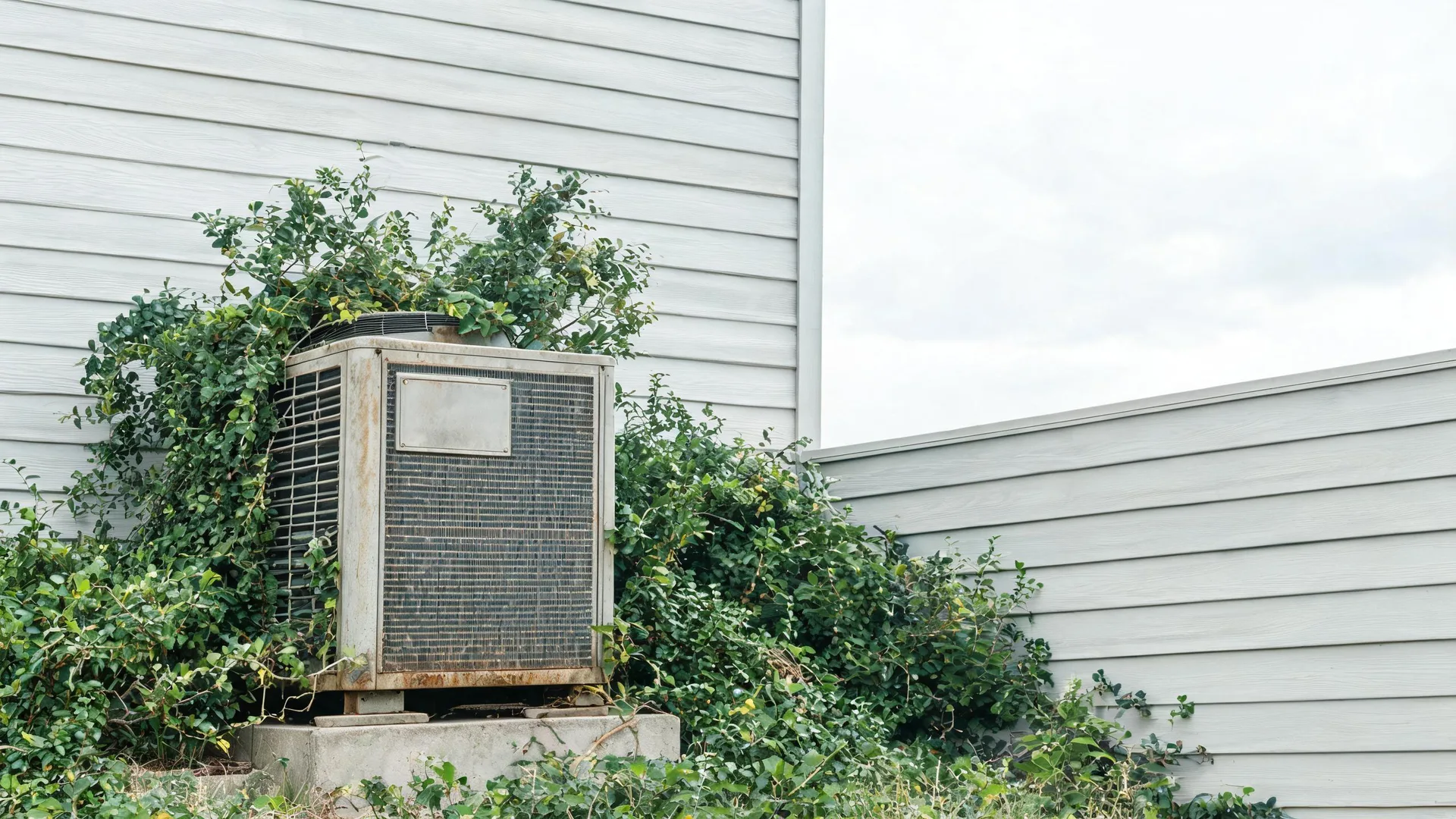
Walk out and look at the outdoor unit. Clear away anything blocking the coil, leaves, snow, a cover left on by mistake. A thin coat of frost in winter is normal, but a unit packed solid in ice is not and shouldn't be chipped at by hand. Pull the filter and hold it to the light. If you can't see through it, swap it or clean it before anyone comes out, since a clogged filter can look like a much bigger problem than it is.

A heat pump that is losing capacity doesn't idle, it runs longer trying to close the gap, and every extra hour it runs shows up on the power bill. Pull last month's statement and compare it to the one from a year ago. A jump that isn't explained by the weather is the system telling you something failed. Power here is cheap, which is exactly why that jump stands out instead of hiding in a bigger number. Waiting through another billing cycle just confirms what a service call would have told you sooner.

A repair makes sense when the failure is isolated and the rest of the system is sound. A capacitor, a contactor, a fan motor, these can be replaced on their own without the rest of the unit caring how old it is. The question changes when the compressor is the one failing, since that's the part everything else depends on and the most expensive to swap out. At that point you're not really asking whether to fix the compressor, you're asking whether the rest of the system has enough life left to be worth pairing with a new one. An outdoor unit that has been through a lot of hard seasons tends to have more than one thing wearing out at once, so a second failure showing up soon after the first isn't rare. A straight answer on repair versus replacement comes from seeing the unit and its history, not from guessing at the part over the phone.