Nine months of heat a year
Furnaces in Foster County run from September through May. That is most of the year, not just a cold snap in January. A furnace sized or installed wrong here does not get a break to make up for it.
Takes about a minute. No obligation.
Furnaces in Foster County run from September through May. That is most of the year, not just a cold snap in January. A furnace sized or installed wrong here does not get a break to make up for it.
Overnight lows average 3°F across December, January and February. A furnace spends those months working near its limit, not just on the worst nights. That kind of load finds the weak point in a system fast, whether it is the wrong size unit or a corner cut on install.
NOAA nClimDiv, 1991–2020 normals
Half the homes in Foster County went up in 1973 or earlier.
A furnace going into a house that old has to match the ductwork and the layout already there, not the other way around.



Foster County is zone 6A, cold enough that the energy code treats it on its own terms. Any furnace going in now has to hit at least 80 percent AFUE, the federal floor for non-weatherized gas furnaces. That floor is set to jump to 95 percent for units built from December 2028 on, so the range of what qualifies is already changing. A homeowner buying this year is choosing inside the current range, not the one coming later. There's also a federal tax credit for high-efficiency equipment worth checking against whatever unit you're comparing, since it applies on top of these minimums.
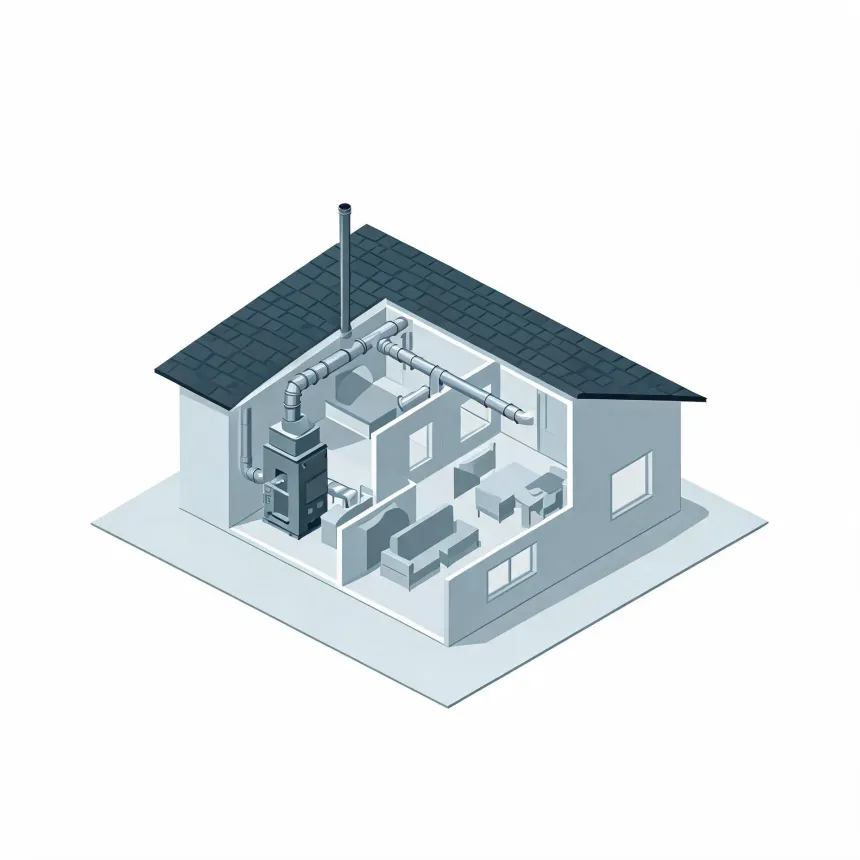
Half the homes in Foster County were built in 1973 or earlier. If yours is one of them, the furnace going in has to match the ductwork and layout already there. Get it sized to your house before you settle on a unit.
Find a contractor
Nine months of runtime does not leave much room for a bad fit. An undersized furnace runs close to flat out for most of September through May, trying to keep up. An oversized one short cycles, switching on and off instead of running steady, and that wears parts sooner too. Either way the problem shows up early here, because the mild stretch that would hide it in other places does not last long in Foster County. Get the unit sized to the house before you pick a model.
AFUE tells you how much of the gas burned turns into heat inside the house, not how the furnace is built. Units with the same rating can still use different igniters, different heat exchangers, different blower motors. Ask what's under the cabinet, not just what's on the sticker.
A higher-efficiency furnace vents through PVC pipe, not a metal flue, because the exhaust runs cooler. That pipe needs a specific path to the outside wall or roof, sloped the right way so condensation drains out instead of back into the unit. If the quote doesn't say where that pipe goes, ask before you sign anything.
Labor is usually the biggest piece of the bill, more than the furnace itself. Swapping a furnace for the same setup in the same spot is one job. Moving the unit, changing vent pipe from metal to PVC, or adding a condensate line for a high-efficiency model is another, because each of those is more time and more material. The ductwork matters too. If the trunk lines and returns already match what the new furnace needs, the crew connects and goes. If they don't, modifying duct to carry the right airflow adds real work before the furnace ever gets set. Permits and inspection are part of the job as well, not an extra, since a furnace is a gas appliance and a vented one at that. None of this is padding. It's what separates a furnace that's been installed from one that's just been dropped in place.
Install day starts with the old furnace coming out, not the new one going in. The crew disconnects the gas line, the vent, the ductwork and the wiring before anything new gets set in place, and that teardown has to happen clean since the new unit will reuse some of those same connections. Once the furnace is set, the sequence runs gas, vent, duct, electrical, in that order, because each connection gets tested before the next one starts. The gas line gets a pressure test for leaks before the burner ever lights. The vent pipe gets checked for the right slope so condensation runs out instead of pooling in the unit. Only after all of that passes does the furnace get fired up and run through a cycle to check the temperature rise and airflow match what the unit is rated for.