A chain-link fence runs diagonally across a mowed green lawn, with two-story houses with white and gray siding and large leafy trees in the background under an overcast sky.

Furnace Maintenance in Fargo, ND

Tell us about the job

Takes about a minute. No obligation.

Tune-up, service, or cleaningFurnace or heatingCass County, ND
Step 1 of 2

What ZIP code is the job in?

Electricity here isn't cheap to waste

North Dakota homes paid $33.73 per million Btu of electricity in 2024. A furnace with a dirty filter or a worn part has to draw more power to put out the same heat. On an electric furnace, that difference shows up directly on the bill.


A tune-up is about what it costs to run

A furnace that's been checked and cleaned burns through less power to heat the same house. In a place where the furnace runs most of the year, that difference adds up fast. The question isn't whether the furnace still works. It's whether it's costing more than it should every month it runs.

Furnaces in Cass County start running in September and go through May.

Get the furnace checked in August, before it has to work.

Electricity heats half the homes here, but not all of them

49.4% of homes heat with electricity
Heat runs September through May
Winter nights average 3°F

Cass County sees its share of rough weather. Between 2015 and 2024 the county logged 354 severe weather events, including 172 windstorms and 109 hail events. That mix is hard on outdoor equipment. Hail dents coils and bends fins, and wind throws branches and debris into the cabinet. Statewide, 7% of North Dakota households lost power for a day or more in 2024, and a furnace with electronic ignition won't run without it. A look at the unit before winter catches dented fins or a cracked housing while they're still a small fix.

A checked furnace costs less to run all winter

A furnace pulling more power than it needs to runs that way for months. Getting it checked now is what sets the bill for the rest of winter.

Find a contractor
A man in a dark jacket, cap and tan work pants carries a canvas tool bag up stone steps toward a navy front door, with a potted shrub beside the entry.
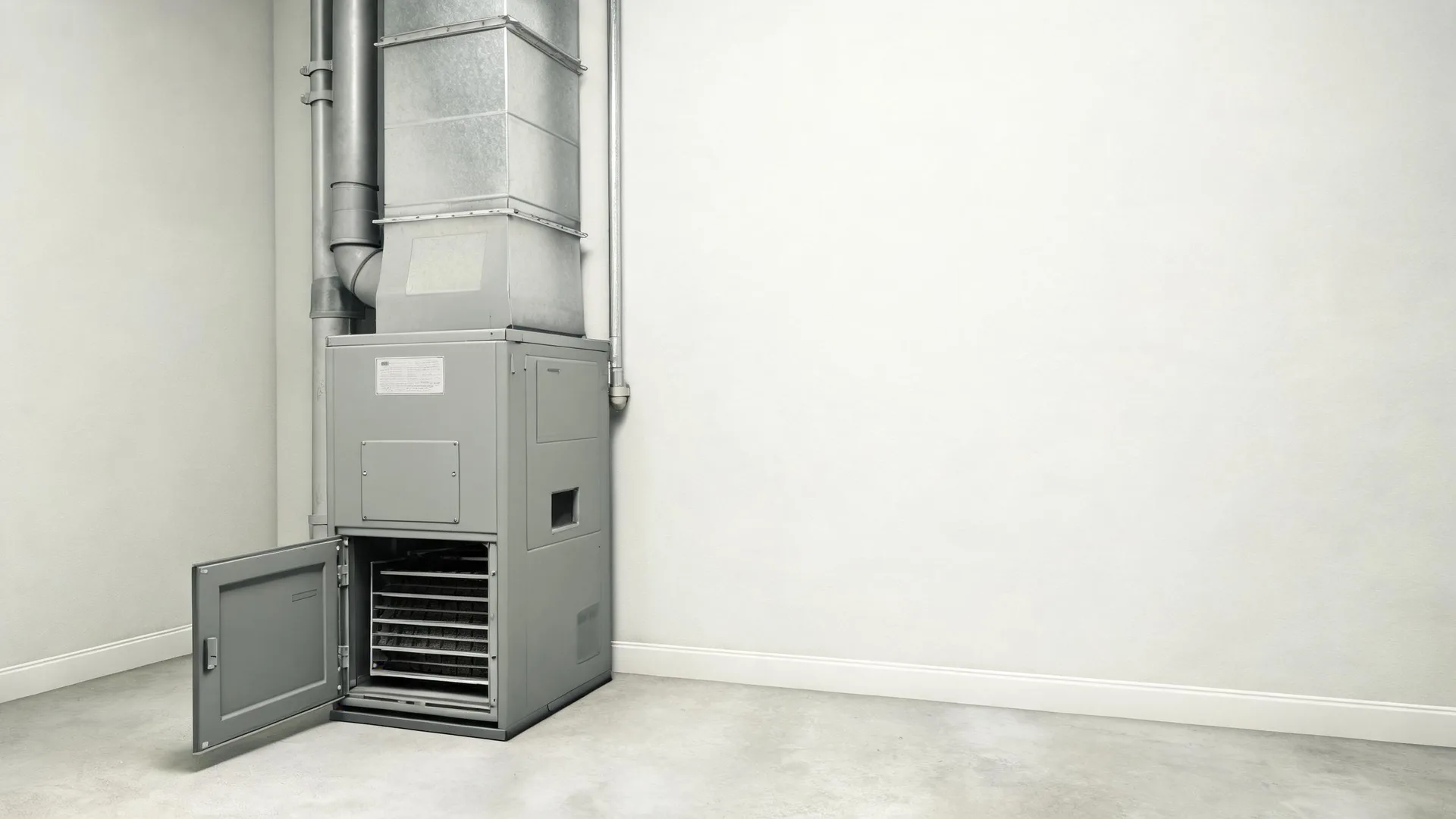
A gray gas furnace with attached ductwork and piping installed in an unfinished concrete basement.

What you can check yourself

The filter is the one thing worth checking without calling anyone. Pull it out, hold it to the light. If you can't see through it, swap it. A clogged filter starves the burner of air and makes the blower work harder to push heat through the house. That alone can shorten the life of the blower motor. Past the filter, leave it alone. Pulling the cabinet to look at the burners or the heat exchanger without knowing what you're looking at does more harm than good. The one exception is the vents. Walk the house and make sure furniture or rugs aren't blocking a supply vent or the return. A blocked return makes the furnace pull air through gaps it wasn't built to pull through, and that strains the blower too.

A dirty filter is where it starts

Air has to move through the filter before the blower can push it anywhere. A filter packed with dust chokes that airflow, and the blower spins longer and harder to force the same heat through the house. The burner can also run hotter than it should, because a furnace reads a lack of airflow as a reason to work harder, not as a reason to stop.

The coil and drain only matter on some systems

If this furnace is paired with central air, it has an evaporator coil sitting in the plenum above it, and that coil has a condensate drain running off it. A coil coated in dust can't pull heat or moisture the way it should, and a clogged drain backs water up into the furnace cabinet instead of outside. Both get checked as part of a tune-up, worth it even in the months the air conditioner sits unused.

Most of what wears out in a furnace doesn't announce itself. A flame sensor coated in a thin layer of oxidation still lights the burner, right up until the morning it doesn't and the furnace shuts itself off as a safety measure. A blower wheel caked in dust still spins, just slower, pushing less air than the furnace thinks it's pushing. A cracked heat exchanger doesn't smoke or spark. It just means combustion gas is getting somewhere it shouldn't, and the only way to catch it is to pull the burners and look with a light in hand. Flame sensors get cleaned or swapped. A blower wheel gets pulled and scraped clean. None of that shows up from across the room, and none of it shows up on the thermostat until the part has already failed.

Half the homes in Cass County were built in 1993 or later. If this one falls on that side, the furnace in it is probably well within its working life, not limping through its last few winters. That's exactly the furnace worth checking every year. Catching a worn igniter or a cracked flame sensor early keeps it running the way it did when it was new, instead of losing a little output each winter until it can't keep up. A furnace that gets looked at before the cold sets in stays efficient for more of its life. One that doesn't tends to need real work sooner.